
Kilimanjaro vs Everest Base Camp: The Summit or the Journey?
VERTICAL SKY · KILIMANJARO VS.
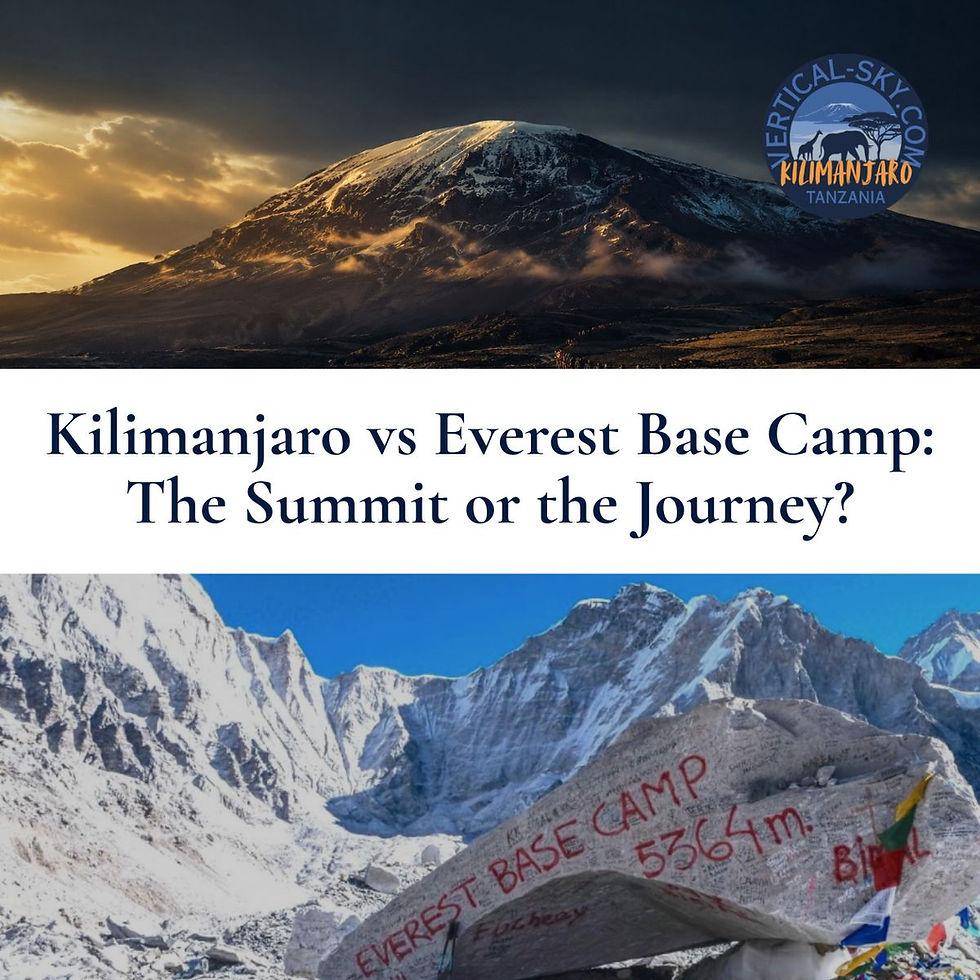
This is the great dinner-table debate of world trekking, and it is really a choice between two opposite prizes. Kilimanjaro gives you a summit of your own: the highest point in Africa, under your boots, earned. Everest Base Camp gives you an audience with the king: a two-week walk through the greatest mountain range on earth to stand at the foot of the highest mountain of all. One puts you on top of something. The other walks you to the bottom of everything. Neither needs ropes, both need respect, and choosing between them is easier once you understand what each one is actually for. Here is the honest comparison.
KILIMANJARO SUMMIT
5,895 m · Uhuru Peak
EBC ALTITUDE
5,364 m · Kala Patthar 5,545 m
KILIMANJARO
TAKES 6 to 9 days
EBC
TAKES 12 to 14 days
KILIMANJARO SLEEPS
Expedition tents
EBC SLEEPS
Sherpa teahouses
What each one actually is
The Everest Base Camp trek is a twelve-to-fourteen-day journey through Nepal's Khumbu region, beginning with the famous short-runway flight into Lukla and climbing gradually through Sherpa villages, Namche Bazaar, Tengboche with its monastery, Dingboche, Lobuche, to Gorak Shep and Base Camp itself at 5,364 metres. Nights are spent in teahouses, simple mountain lodges with beds, dal bhat and a stove in the dining room, and the trek is walked in the company of one of the great mountain cultures on earth. And here is the detail most people miss: Base Camp itself sits under the shoulder of the mountain, so the trek's true high point and its postcard view of Everest come from the pre-dawn climb of Kala Patthar at 5,545 metres. There is no summit on this trip. The prize is the place, the range, and the journey itself.
Kilimanjaro is the opposite proposition: a six-to-nine-day fully supported expedition, tents carried and camps built by your crew, through five climate zones to an actual summit, the highest in Africa at 5,895 metres, higher than anywhere the EBC trek touches. The prize is not a place you visit. It is a thing you did.
The comparison, honestly. Kilimanjaro vs Everest base camp.
Altitude, and two different shapes of it
On paper Kilimanjaro goes higher: Uhuru Peak stands 350 metres above even Kala Patthar. But the two treks deliver altitude in completely different shapes. Kilimanjaro is a spike: up and down in a week, with one huge summit night. EBC is a soak: two weeks of walking and, crucially, sleeping at serious altitude, night after night above 4,000 and then 5,000 metres, with acclimatisation days built in at Namche and Dingboche. Both shapes produce real altitude illness in the unprepared, and both reward the same virtues, hydration, pacing, honesty about symptoms. The spike asks for one heroic effort. The soak asks for two weeks of patience.
Difficulty
Day for day, EBC is the gentler walk: shorter hours, teahouse comforts, no single day as demanding as Kilimanjaro's summit night, which climbs a vertical kilometre and descends more in one push. Overall, EBC asks for more time and more sustained altitude discipline, while Kilimanjaro asks for one bigger physical effort and rewards it with a summit. If your fitness worry is endurance over weeks, Kilimanjaro is kinder. If your worry is one brutal night, EBC is kinder. Neither requires any technical skill whatsoever.
The experience
This is where they diverge completely. EBC is cultural immersion: villages, monasteries, prayer flags, bakeries improbably serving apple pie at 4,000 metres, and the constant company of other trekkers on the world's most famous trail, it is sociable, storied and busy in season. Kilimanjaro is wilderness immersion: five climate zones with no villages after the gate, your own crew as your travelling community, and a summit night under stars that belongs entirely to your group. One is a journey through a living culture to a legendary place. The other is a private expedition to a personal triumph.
Logistics, seasons and cost
EBC runs in two main windows, roughly March to May and October to November, and hangs on the Lukla flight, which weather can delay in either direction, so itineraries need slack. Trekking with a guide and porter is the norm in Nepal and in most cases now required. Kilimanjaro climbs in almost any month, needs no internal flight, and dates flex around your life. Costs for properly run versions of both sit in the same broad territory, a few thousand once flights and support are counted, and the rule of this entire series applies equally in the Khumbu and on Kilimanjaro: the cheap version is cheap because of what it quietly removed, usually the welfare of the people carrying your world.
Which one, and in which order
Choose by the prize. If what stirs you is Everest itself, the history, the range, the culture, the name, then EBC will move you in ways no other trek can, and no summit is required to justify it. If what stirs you is achievement, standing on top of something enormous because you climbed it, then Kilimanjaro is simply the better answer: higher, wilder, and yours. And if, like many of our climbers, the honest answer is both, do Kilimanjaro first. A Kilimanjaro summit teaches you how your body handles serious altitude inside one intense week, knowledge that makes two patient weeks in the Khumbu feel comfortable rather than worrying, and it means you walk into the amphitheatre of the greatest range on earth already carrying a summit of your own.
Our honest take: this is the easiest disagreement in trekking because both sides are right. EBC is the greatest journey in world walking. Kilimanjaro is the greatest summit in world walking. The only mistake is expecting one to be the other: go to the Khumbu for the pilgrimage, come to Tanzania for the triumph. And if the plan is both in a lifetime, start with the triumph, the mountain that crowns you first makes every mountain after it feel like an old friend.

Frequently asked questions
Which is harder, Kilimanjaro or Everest Base Camp?
They are hard differently. Kilimanjaro packs its difficulty into one week and one enormous summit night, climbing higher than anywhere the EBC trek reaches. EBC spreads gentler days over two weeks of sustained sleeping altitude. Most trekkers find Kilimanjaro's peak effort harder and EBC's duration more wearing. Neither is technical.
Is Kilimanjaro higher than Everest Base Camp?
Yes. Uhuru Peak stands at 5,895 metres, while Base Camp sits at 5,364 and the trek's true high point, Kala Patthar, at 5,545. A Kilimanjaro summiteer stands 350 metres higher than an EBC trekker ever does, on an actual summit rather than a viewpoint.
Do you summit anything on the Everest Base Camp trek?
No summit is involved. Base Camp itself has no view of Everest's peak, which is why trekkers climb Kala Patthar at 5,545 metres, a walking viewpoint, for the classic panorama. The prize of EBC is the journey, the Khumbu culture and the place itself rather than a summit.
Should I do Kilimanjaro or Everest Base Camp first?
If both are on your list, Kilimanjaro first is the smarter order: it teaches you how your body handles serious altitude within one supported week, making the sustained two-week altitude of the Khumbu feel far more comfortable, and you arrive at the foot of Everest already carrying a summit of your own.
Come and claim the summit first
Ethical, expertly guided Kilimanjaro expeditions: the greatest summit in world walking, done properly, before you go and meet the king.
Prefer to listen to the Podcast? Click here 👇
Vertical Sky. Ethical Kilimanjaro climbs. Written by Vertical Sky.


Comments