
Marangu Route
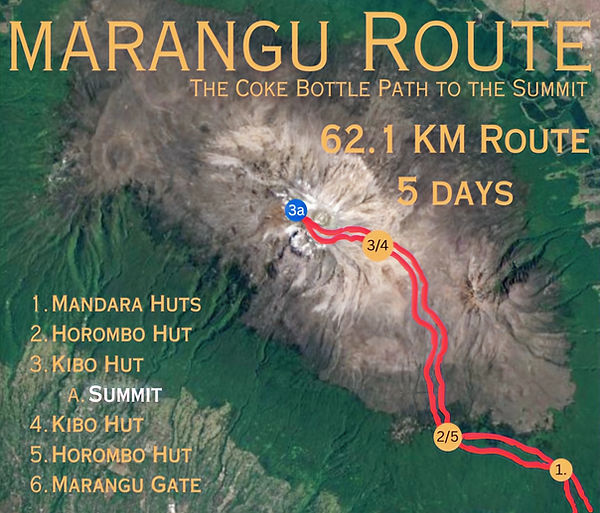
Marangu Route Map
The Classic Path Up Kilimanjaro
Marangu climbs Kilimanjaro's south-eastern side from Marangu Gate, following the mountain's oldest path through Mandara and Horombo to Kibo Hut, and summiting via Gilman's Point. Uniquely, you descend the same trail you climbed, which is why Marangu is the only route walked in both directions, and the only one where you sleep in huts rather than tents the whole way.
Want to fly through it day by day?
Explore our interactive Marangu route map, where you can tap every hut and see the elevation profile for each stage.
The Marangu Route is Kilimanjaro's most accessible trail, the only route on the mountain with hut accommodation, making it ideal for those who prefer not to camp. Shorter acclimatisation time means a lower summit rate than longer routes, but with proper preparation and the right operator behind you, it remains a deeply rewarding climb. We recommend the 6-day option wherever possible.
This guide covers the route map, the huts, the day-by-day itinerary, difficulty, honest success rates, costs, and how Marangu compares with Machame.
Start Location: Marangu Gate (1,860m / 6,100ft)
Your journey begins in lush rainforest, known for its vibrant flora and fauna, and the chance
to learn about the local Chagga tribe communities along the way.
Day 1: Marangu Gate to Mandara Hut
-
Distance: ~8 km / 5 miles
-
Duration: 3-4 hours
-
Environment: Tropical rainforest, birdlife, and orchids.
Day 2: Mandara Hut to Horombo Hut
-
Distance: ~12 km / 7.5 miles
-
Duration: 5-6 hours
-
Environment: Moorland, with views of Mount Kibo and Mount Mawenzi, lush grasses, and scattered acacia.
Day 3: Acclimatization Day at Horombo
Optional short hikes to help acclimate and enjoy views of Kilimanjaro’s peaks and surrounding plains.
Day 4: Horombo Hut to Kibo Hut
-
Distance: ~13 km / 8 miles
-
Duration: 6-7 hours
-
Environment: From lush moorlands to the stark, volcanic landscape of Kibo, with a base for your summit assault.
Night Climb: Kibo Hut to Uhuru Peak & Return
-
Distance: ~4 km / 2.5 miles (one way)
-
Duration: 6-8 hours round trip (start late at night)
-
Environment: Wind-swept icy terrain, glaciers, and the thrill of standing atop Africa.
Experience an unforgettable dawn at the summit, then descend back to Kibo or Horombo Camp.
Day 5: Descend to Mandara or Marangu Gate
-
Distance: 9-14 km / 5.5-8.7 miles
-
Duration: 4-5 hours
-
Environment: Forests and lush landscapes, completing your journey through Kilimanjaro’s diverse ecosystems.
Summary of the Marangu Trek
-
Duration: 5-6 days (short and manageable)
-
Total Distance: 62-70 km / 38-43 miles
-
Difficulty Grade: 2/5 Suitable for beginners, families, and those with limited time.
-
Success Rate: 50-60% (less acclimatization time means slightly lower success unless properly prepared)
-
Required Fitness: Moderate, core walking fitness helps, but technical skills are not required.
Why Climb the Marangu Route?
-
Convenience & Comfort: Simple huts with basic facilities mean less camping gear and more comfort.
-
Fast & Efficient: Ideal for those with limited time or first-time climbers seeking a less strenuous ascent.
-
Cultural Experience: Easy access to Chagga villages and local communities along the route.
-
Great for Families & Beginners: Low-to-moderate challenge, making it accessible for all.
Is the Marangu Route for You?
If you’re looking for a straightforward, memorable Kilimanjaro experience with a bit of comfort and cultural immersion, the Marangu Route is your perfect path. It’s suited to first-time climbers, families, and those with limited time but eager for the full Kilimanjaro adventure.
The Huts on the Marangu Route
Marangu's three hut stations are the only permanent accommodation on Kilimanjaro. Mandara Hut (2,700m) sits in the forest a half day above the gate; Horombo Hut (3,720m), the route's hub, is a village of A-frame cabins with views to Mawenzi and Kibo, where climbers on 6 day itineraries spend their acclimatisation day; and Kibo Hut (4,700m), a stone-built base on the saddle, is where you attempt sleep before the midnight summit push. Huts have shared bunkrooms, mattresses and communal dining: no tents to pitch, no sleeping mats on the ground, and a warm room at the end of every day.
"Sometimes it's just the camping that puts people off climbing Kilimanjaro,
The Marangu Route makes it accessible for all.
It offers a different kind of comfort on the mountain" Jenson - Founder
How Hard Is the Marangu Route?
We grade Marangu 2 out of 5 for its walking: the gradients are the gentlest on the mountain and the huts remove the rigours of camp life. But there is a trap in that gentleness, and it is the most important honest thing we can tell you about this route: the standard 5 day itinerary is simply too fast for most bodies to acclimatise, which is exactly why the easiest walk on Kilimanjaro produces its lowest summit rates. Marangu is easy underfoot and unforgiving overhead.
Why Is Marangu Called the Coca-Cola Route?
The oldest nickname on the mountain. In the early trekking days, Marangu's huts sold soft drinks to climbers, and the name stuck as shorthand for the comfortable option, in contrast to the wilder Machame trail, which was duly christened the whiskey route. We tell the whole story in our Machame route guide. The nicknames are affectionate, but they carry a warning: Coca-Cola comfort has tempted many climbers into taking the mountain too lightly.
Marangu Route Success Rate (the honest version)
This is where we are more honest than the brochures. The 5 day Marangu itinerary has the lowest success rate on Kilimanjaro, at roughly 27 percent, because it simply climbs too fast. Adding the sixth day with an acclimatisation night at Horombo lifts typical success to around 50 to 60 percent, which is why we strongly recommend 6 days. Our own Marangu success rate is 84 percent. If summiting matters more to you than the huts, our honest advice is a longer camping route. Read our full breakdown of Kilimanjaro success rates by route.
Best Time to Climb the Marangu Route
Marangu's huts make it the most weatherproof route in the wet: you sleep dry whatever the sky does, and it is the route we suggest for climbers who must travel near the rainy seasons but do not fancy Rongai's remoteness. In the main dry seasons, January to early March and June to October, all routes shine. See our honest month-by-month guide to the best time to climb Kilimanjaro.
What Does the Marangu Route Cost?
Our Marangu expeditions start from $3,850 per person, including transfers, hotel nights in Arusha, all park fees, hut fees and KINAPA levies, certified guides, fair-paid porters, all meals on the mountain, and supplemental oxygen carried on every expedition. Marangu's hut fees replace camping costs, which keeps it among the most affordable ways up the mountain. A 20 percent deposit secures your place. See our full dates and prices, or read our prices explained page.
Marangu or Machame?
The Coca-Cola route or the whiskey route: huts, gentle gradients and the shortest itinerary, against tents, bigger scenery and better acclimatisation. If sleeping under a roof is what gets you on the plane, Marangu on 6 days is a fine climb. If summit probability is your priority, Machame on 7 days beats it comfortably. Read the full Machame route guide and map to compare.
Frequently Asked Questions
How long is the Marangu route?
Around 62 to 70 km (38 to 43 miles) over 5 or 6 days, ascending and descending the same south-eastern trail, the only Kilimanjaro route walked in both directions.
Does the Marangu route have huts?
Yes, and it is the only route that does: Mandara Hut (2,700m), Horombo Hut (3,720m) and Kibo Hut (4,700m), with shared bunkrooms, mattresses and communal dining. No camping equipment is needed.
What is the success rate on the Marangu route?
Roughly 27 percent on the 5 day itinerary, the lowest on the mountain, rising to around 50 to 60 percent with the 6 day version's acclimatisation night. Our own rate is 84 percent.
Why is Marangu called the Coca-Cola route?
Its huts historically sold soft drinks to climbers, and the name became shorthand for the comfortable option, in contrast to the wilder Machame 'whiskey' route.
Is Marangu the easiest way up Kilimanjaro?
It has the gentlest walking and the comfort of huts, but its short itinerary gives poor acclimatisation, so it is statistically the hardest route to actually summit. Easy underfoot is not the same as easy on the body.
Marangu or Machame: which should I choose?
Marangu on 6 days if hut accommodation is what makes the climb possible for you; Machame on 7 days if maximising your summit chances matters more.