
Why You Should Climb Kilimanjaro
By Vertical Sky · Honest guides to Africa's highest mountain
THE SHORT ANSWER
People climb Kilimanjaro for a hundred different reasons, and almost all of them turn out to be right. It's the achievement of a lifetime, and scenery you'll find nowhere else on earth. It gives something back to your mind and your body, it forges friendships that outlast the trip, and, climbed with the right company, it puts real income and dignity into the hands of the Tanzanian crews who make it possible. Here's the honest case for why you should climb it.
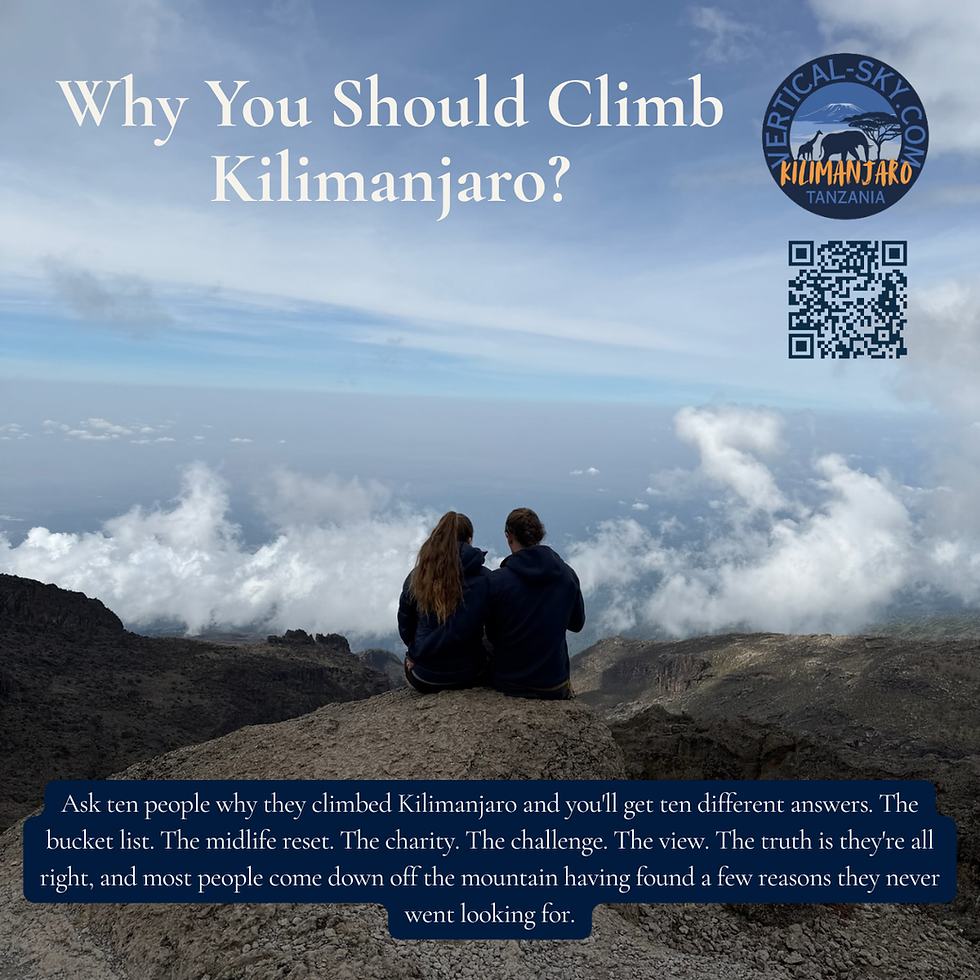
Ask ten people why they climbed Kilimanjaro and you'll get ten different answers. The bucket list. The midlife reset. The charity. The challenge. The view. The truth is they're all right, and most people come down off the mountain having found a few reasons they never went looking for.
I climbed it as a middle-aged bloke who needed something to change, and it gave me back far more than I'd bargained for. So here, honestly, is why I think you should climb it too.
Because it's the achievement of a lifetime
Some things you carry for the rest of your life. Standing on the Roof of Africa, 5,895 metres up, having walked every single step there yourself, is one of them. It isn't something you can buy, fake or shortcut. You earn it, metre by hard-won metre, and nobody can ever take it from you. For the rest of your days, on the mornings when you doubt yourself, you'll have this in your back pocket: I climbed Kilimanjaro. That kind of proof quietly changes how you see what you're capable of, in every other corner of your life.
Because you'll witness scenery you'll find nowhere else
In a single week you walk from the equator to the Arctic. You start in steamy rainforest alive with birdsong, climb through heather and moorland, cross a high alpine desert that looks like the surface of the moon, and finish in a frozen world of ancient glaciers and ice. You watch the sun rise above an endless ocean of cloud, with the curve of the earth laid out in front of you. There is nowhere else on the planet that stacks so many worlds on top of one another. And you don't just see it. You walk right through it.
Because of the feeling at the summit
I won't try too hard to describe this, because words don't quite reach it. But there's a moment, cresting the crater rim as the sun comes up, exhausted and frozen and overwhelmed, when something cracks open in you. People weep up there. Tough, composed people who haven't cried in years. It's the relief, the disbelief, the beauty and the sheer enormity of having actually done it, all at once. Whatever you carried up the mountain, you tend to set a little of it down at the top.
Because of the good you do
Here's a reason most people don't think about until they're on the mountain. Kilimanjaro is climbed on the backs of an extraordinary local crew, guides, cooks and porters who carry the camp, the food and often your spirits all the way to the top. When you climb with a company that pays and treats them properly, your trip becomes a livelihood for Tanzanian families and a source of real dignity for the people who make it possible. At Vertical Sky we pay above the recommended KPAP wage rates by design, because the mountain should lift up the people who call it home, not exploit them. Climb the right way and your adventure does genuine good, long after you've flown home.
Because of what it does for your mind
A week of movement, fresh air, time off your phone and a single clear goal does remarkable things for your head. People come down calmer, clearer and more sure of themselves than they've felt in years. It isn't a cure for anything, and it's no substitute for proper support if you're genuinely struggling, but as a reset for a tired, noisy mind, few things on earth compare.
Because of what it does for your body
And this benefit starts long before you reach Tanzania. Preparing for Kilimanjaro means months of training, walking, hiking, building strength, and that preparation is a gift in itself. Most people arrive at the mountain fitter than they've been in years, and the habits they built getting ready have a way of sticking around long after the climb. You set out to climb a mountain, and quietly transform your health in the process.
Because of the people you'll climb with
You start as a group of strangers and finish as something much closer to family. There's something about shared hardship, the cold, the early starts, the summit night none of you will ever forget, that bonds people faster and deeper than ordinary life ever manages. Add the guides and porters who look after you every step, and you come home with friendships that genuinely last. Plenty of our climbers are still in touch years later. You don't just climb a mountain. You join a small, lifelong club of people who did.
So, why should you climb Kilimanjaro?
For the achievement. The scenery. The summit. The good it does. Your mind, your body, the people. But underneath every one of those is a single, simpler reason: it changes you. You come down a slightly different person from the one who went up, a bit braver, a bit clearer, a bit more certain that you can do hard things. That's the real reason. Everything else is a bonus. And those famous snows won't be there forever, but that's a story for another day.
Feel that pull? That's usually the mountain.
If any of this has stirred something in you, start by seeing where you stand. Our free 60-second readiness planner gives you an honest score and a plan. No pressure, no sales.
Frequently asked questions
Why should you climb Kilimanjaro?
Because it's a genuine achievement of a lifetime, with scenery you'll find nowhere else, a summit moment few experiences match, and lasting benefits for your mind, body and friendships. Climbed with an ethical operator, it also supports the livelihoods of the local Tanzanian crews. Most of all, it tends to change how you see what you're capable of.
What are the benefits of climbing Kilimanjaro?
The benefits include a deep and lasting sense of achievement, extraordinary and varied scenery, improved fitness from months of training, a real reset for your mental wellbeing, lifelong friendships forged on the mountain, and the good you do for local communities when you climb with a fair, ethical company.
Does climbing Kilimanjaro change you?
For many people, yes. Earning the summit through your own effort tends to shift how you see your own capability, and the combination of challenge, perspective and time away from everyday life often leaves climbers calmer, clearer and more confident long after they return home.
How does climbing with an ethical operator help local people?
Your trip directly supports the guides, cooks and porters who make the climb possible. An ethical operator pays fair wages, provides proper kit and treats crews with dignity, so your adventure becomes meaningful income for Tanzanian families rather than exploitation. At Vertical Sky we pay above the recommended KPAP wage rates by design.
Is climbing Kilimanjaro worth it?
For the overwhelming majority of people who do it, yes. It is hard, but the achievement, the scenery, the summit feeling and the personal change it brings make it one of the most rewarding things you can do. With the right preparation and a good operator, it is also far more achievable than most people assume.
Vertical Sky · vertical-sky.com · info@vertical-sky.com · +971 52 816 6070


Comments