
The Vanishing Snows of Kilimanjaro
By Vertical Sky · Honest guides to Africa's highest mountain
THE SHORT ANSWER
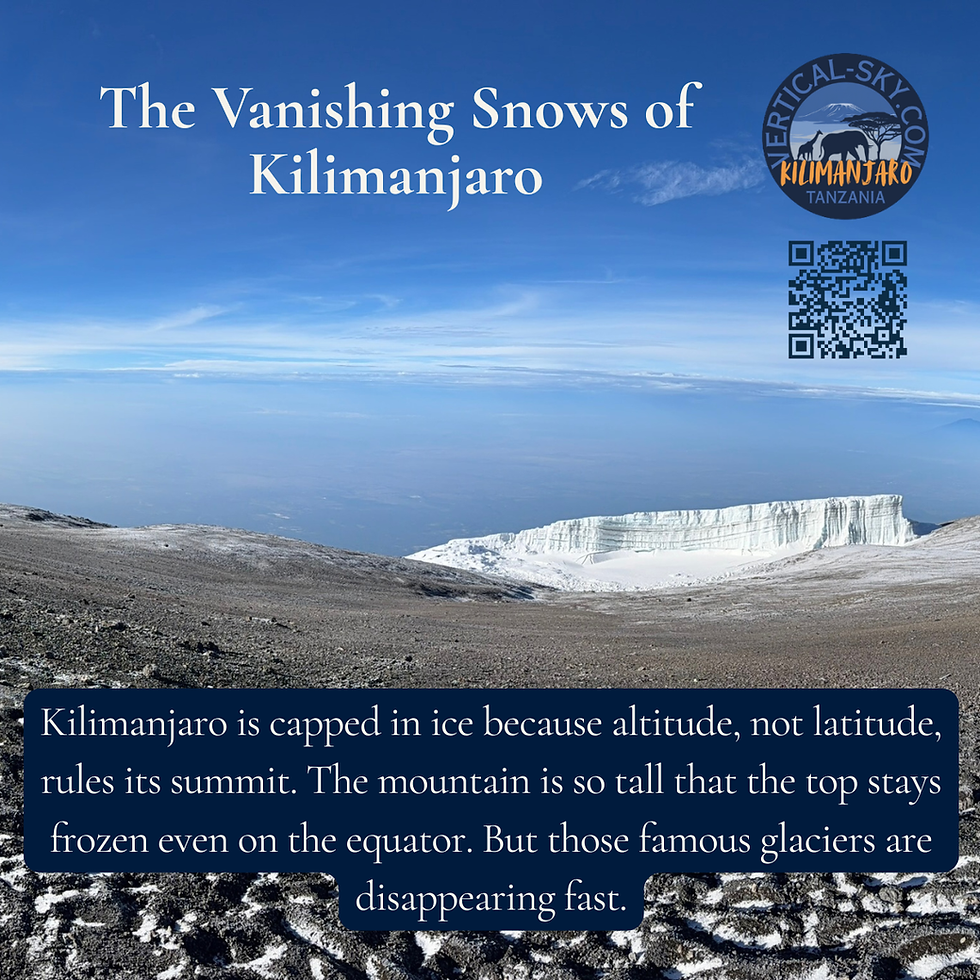
Kilimanjaro is capped in ice because altitude, not latitude, rules its summit. The mountain is so tall that the top stays frozen even on the equator. But those famous glaciers are disappearing fast. More than 85% of the ice has melted away since 1912, and scientists expect what remains to be largely gone within a few decades. This may be one of the last generations able to stand beside them.
There is something almost impossible about it. A mountain sitting barely three degrees from the equator, in tropical East Africa, crowned with glaciers. Ernest Hemingway made them legendary in his 1936 story "The Snows of Kilimanjaro", and for a century those white ice fields, glittering above the African plains, have been one of the most extraordinary sights on Earth.
And in our lifetime, they are quietly slipping away. Here is the science of how the ice got there, the hard truth about why it is going, and an honest case for seeing it while you still can.
How can a mountain on the equator be covered in ice?
The answer is beautifully simple: when it comes to temperature, how high you are matters far more than how far you are from the equator. Latitude sets the climate at sea level. Altitude rules it at the top.
Air cools by roughly 6.5°C for every 1,000 metres you climb. Uhuru Peak, Kilimanjaro's summit, stands at 5,895 metres, so the air up there is around 38 degrees colder than at the base. While the rainforest at the foot of the mountain sits at a warm, humid 25 to 30°C, the summit averages around minus 7°C and plunges well into the minus 20s at night.
Once it is that cold, the moisture that reaches the summit falls as snow rather than rain.
Over many thousands of years, that snow compacted into glacial ice. The ice on Kilimanjaro is ancient, around 11,000 years old, older than the pyramids, older than almost anything humans have built. The equator gives the mountain its lush, green base. Its sheer height gives it a frozen crown.
The snows that made the mountain famous
What sits up there are three remaining ice bodies: the Northern Ice Field, the Southern Ice Field, and the Furtwängler Glacier, named after the first man to ski down the mountain in 1912. To stand beside them at sunrise, on the equator, having walked up through rainforest and moorland and high desert to reach them, is one of the great experiences in travel. They feel like something that should not be there, and soon, they may not be.
The hard truth: they are vanishing
The numbers are stark. In 1912, Kilimanjaro carried around 12 square kilometres of ice. By 2011 that had collapsed to under 2 square kilometres. More than 85% of the mountain's ice has disappeared in a single century, and the rate has been accelerating.
85%+of Kilimanjaro's ice has vanished since 1912
The remaining glaciers are not just shrinking outward, they are thinning rapidly from above and breaking apart. The Furtwängler Glacier lost roughly half its thickness in under a decade and has already split in two. As NASA has put it, the question is no longer whether Kilimanjaro's ice will disappear, but when. Many scientists expect the glaciers to be largely gone within the next few decades, with a good number of estimates pointing to around 2050.
Why is it happening? It is not the simple story you would expect
Here is the part most people get wrong. It is tempting to assume the ice is simply melting because the air got too warm. But the summit is still firmly below freezing, year round. The real story is more subtle, and more interesting.
The glaciers are disappearing largely because they are no longer being replenished. A drier atmosphere over East Africa means less snowfall to top the ice up. And under the intense equatorial sun, much of the existing ice does not melt at all, it sublimates, turning straight from solid into vapour without ever becoming water. Warming plays its part in the wider picture, but the heart of it is this: the ice is being lost faster than nature can replace it, and the replacement has all but stopped.
See them before they are gone
We are not telling you this to rush you onto a plane. We are telling you because some things are genuinely worth seeing while they are still here, and the snows of Kilimanjaro are near the top of that list.
Think about what it means to climb this mountain right now. In a single week you walk from the equator to the Arctic, up through five climate zones, until you crest the crater rim at dawn and find yourself standing beside ancient glaciers that have crowned this mountain for eleven thousand years, and that your grandchildren may only ever see in photographs.
There are not many experiences left on Earth that carry that kind of weight.
If you do go, go gently. Climb with an operator who treads lightly on the mountain, pays and treats its crews properly, and leaves no trace behind. The least we can do, when visiting something this fragile, is visit it with respect.
Stand beside the snows while they last
Every one of our routes reaches the ice at the summit. See all six on our interactive route map, then check your readiness for the climb in 60 seconds.
Frequently asked questions
Why does Kilimanjaro have snow and ice at the equator?
Because altitude matters far more than latitude for temperature. Air cools by about 6.5°C per 1,000 metres climbed, and at 5,895 metres Kilimanjaro's summit is permanently below freezing, averaging around minus 7°C. At that height, precipitation falls as snow, which built the mountain's glaciers over thousands of years.
How much ice has Kilimanjaro lost?
More than 85% of its ice has disappeared since 1912, falling from around 12 square kilometres to under 2. The remaining glaciers are also thinning rapidly and breaking apart, and the rate of loss has been accelerating.
When will Kilimanjaro's glaciers disappear?
Scientists no longer ask whether the ice will go, but when. Most projections expect the glaciers to be largely gone within the next few decades, with many estimates pointing to around 2050.
Why are the glaciers melting if the summit is below freezing?
It is not a simple melting story. The summit stays cold, but a drier atmosphere means far less snowfall to replenish the ice, and the intense equatorial sun causes much of it to sublimate, turning straight from ice to vapour. The ice is being lost faster than it can be replaced.
Can you still see the glaciers when you climb Kilimanjaro?
Yes. Every standard summit route brings you up onto the crater rim beside the Northern and Southern Ice Fields, and you reach them at sunrise on summit morning. For now, the snows of Kilimanjaro are still very much there to be seen.
Ready to stand on the Roof of Africa?
Start with your free 60-second readiness check, or talk to us about the route that gives you the best chance of the summit, and the ice.
Vertical Sky · vertical-sky.com · info@vertical-sky.com · +971 52 816 6070


Comments