
Racing the Roof of Africa: Kilimanjaro's Speed Records, and Today's 16-Hour Attempt
VERTICAL SKY · THE JOURNAL
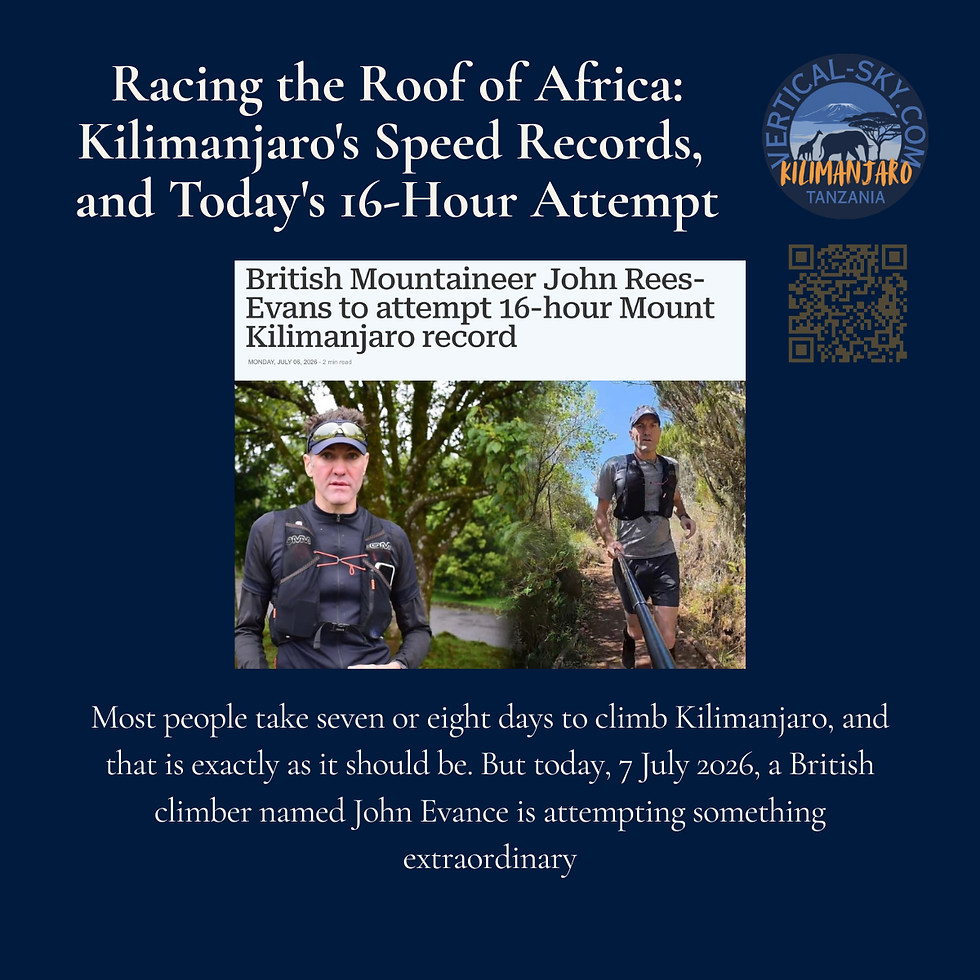
Most people take seven or eight days to climb Kilimanjaro, and that is exactly as it should be. But today, 7 July 2026, a British climber named John Evance is attempting something extraordinary: the summit and back within 16 hours, starting not from a park gate but from a village he believes marks the true foot of the mountain. It is a good moment to tell the story of Kilimanjaro's speed records, the astonishing athletes who hold them, and why, for the rest of us, slow will always be the way.
TODAY'S ATTEMPT
Summit and back in 16 hours
FASTEST ROUND TRIP
6 hrs 42 min, Karl Egloff
UNSUPPORTED RECORD
9 hrs 21 min, Simon Mtuy
FASTEST WOMAN (ASCENT)
8 hrs 32 min, A-M Flammersfeld
TYPICAL TREK
7 to 8 days
THE SUMMIT
Uhuru Peak, 5,895 m
Today: the 16-hour attempt from Mabungo
John Evance's attempt has a twist that makes it more interesting than the clock alone. Rather than starting at the Marangu or Umbwe gates, where most previous record attempts have begun, he is starting in Mabungo village. From there he cycles to Marangu Mtoni, runs up the mountain by the Marangu route to Uhuru Peak, then descends through Maua village and back to Mabungo, where the attempt ends. His reasoning, based on his research into the mountain's history and geography, is that Mabungo is where Kilimanjaro truly begins.
There is a lovely stubbornness to that. And a story behind it too: he attempted a similar feat 26 years ago and was forced to abandon it with health complications. A quarter of a century later, he is back to finish the job.
Where does a mountain actually begin?
It sounds like a philosopher's question, but on Kilimanjaro it is a practical one. The mountain is the tallest free-standing mountain on earth, a single vast massif rising straight out of the plains, and where you choose to draw its starting line changes everything about a speed record. The park gates are administrative boundaries, not geographical ones. The villages on the lower slopes, places like Mabungo, sit on the mountain itself, on soil that is already Kilimanjaro. Start there and you are climbing the whole mountain, not just the part inside the national park. Whatever the clock says tonight, that idea deserves respect.
The record book
Speed climbing on Kilimanjaro has a longer history than most people realise. Informal attempts go back to British expatriates living near the mountain as early as the 1960s. The modern era, though, belongs to a handful of astonishing athletes.
The fastest of all: Karl Egloff
The Ecuadorian-Swiss mountain runner holds the benchmark that makes everyone else on the mountain feel slow: up and down in 6 hours and 42 minutes. He rested for around three minutes on the summit, then ran back down to the gate in 1 hour 42 minutes. For perspective, that descent alone covers ground most trekkers take two full days to walk.
The one he beat: Kilian Jornet
Before Egloff, the round-trip record belonged to Kilian Jornet, the greatest mountain runner of his generation, at 7 hours 14 minutes. Egloff took the record by 32 minutes, which in this sport is a landslide.
The unsupported king: Simon Mtuy
Perhaps the most remarkable mark of all belongs to a Tanzanian. Simon Mtuy set the verified men's unsupported ascent and descent record, 9 hours, 21 minutes and 47 seconds, carrying his own food and water, a feat that appeared in the 2010 Guinness Book of World Records. No support crew, no aid stations, just a man and his mountain.
The women's progression
The first woman to attempt to run up Kilimanjaro in a single day did so in 2005, summiting unacclimatised in 13 hours 16 minutes, a mark that stood for more than six years. It fell to Debbie Bachmann, a Kilimanjaro group leader, at 11 hours 51 minutes, and then in July 2015 the German sports scientist and ultra-runner Anne-Marie Flammersfeld brought the women's ascent down to a staggering 8 hours 32 minutes.
Our honest take: these records are magnificent, and they are also completely irrelevant to how you should climb Kilimanjaro. The athletes above are among the finest endurance specialists on earth, they train at altitude for a living, and every serious attempt is made with rapid-descent plans in place if the altitude strikes. The average climber who tries to rush this mountain does not set a record. They get altitude sickness, and they go home without the summit.
Why slow wins for the rest of us
Here is the paradox the record book hides: on Kilimanjaro, speed is the enemy of success. The single biggest factor in whether an ordinary climber reaches Uhuru Peak is acclimatisation, the days spent letting your body adapt to the thinning air, and there is no shortcut to it. It is why the longer routes carry the highest summit success rates, why we build climb-high, sleep-low days into every itinerary, and why the two words you will hear most on the mountain are pole pole. Slowly, slowly.
So enjoy today's attempt, cheer the man from Mabungo, and marvel at Egloff's 6 hours 42. Then, when you plan your own climb, do the opposite of everything they did. Take the eight days. Walk it slowly. The mountain rewards patience far more often than it rewards speed.
Frequently asked questions
What is the fastest ascent and descent of Kilimanjaro?
Karl Egloff holds the fastest known round trip, climbing and descending Kilimanjaro in 6 hours 42 minutes, beating Kilian Jornet's previous mark of 7 hours 14 minutes by 32 minutes.
What is the unsupported Kilimanjaro speed record?
Tanzanian mountain guide Simon Mtuy set the verified men's unsupported ascent and descent record of 9 hours 21 minutes 47 seconds, carrying his own food and water, a mark recognised in the 2010 Guinness Book of World Records.
Who is the fastest woman on Kilimanjaro?
German sports scientist and ultra-runner Anne-Marie Flammersfeld set the fastest known women's ascent, 8 hours 32 minutes, in July 2015, lowering marks previously set at 11 hours 51 minutes and, in 2005, 13 hours 16 minutes.
Is it safe to climb Kilimanjaro in one day?
Not for ordinary climbers. Speed records are set by elite endurance athletes with altitude training and rapid-descent contingencies in place. For everyone else, altitude sickness makes rushing the mountain dangerous, and a seven or eight day itinerary with proper acclimatisation gives by far the best and safest chance of reaching the summit.
Climb it the way the mountain likes
Ethical, expertly guided Kilimanjaro expeditions over seven and eight days,
with fairly paid crews, oxygen on every climb,
and all the time your body needs.
Prefer to listen to the Podcast then click here 👇
Vertical Sky. Ethical Kilimanjaro climbs. Written by Vertical Sky .


Comments