
The Five Climate Zones of Kilimanjaro: Plants, Wildlife and Landscapes, Stage by Stage
VERTICAL SKY JOURNAL
Climb Kilimanjaro and you pass through five completely different ecological zones, one stacked on top of the other, from warm cultivated farmland at the base to a frozen arctic summit nearly six kilometres up. In the space of a week you travel the rough equivalent of walking from the equator to the poles. Each zone has its own climate, its own plants and its own wildlife, and they shift dramatically as you climb, because the higher you go, the colder and drier it gets. Here is the mountain, stage by stage.
The reason the zones exist at all is simple. Altitude drives temperature and rainfall. As you gain height the air cools steadily, and the rain that soaks the lower forest thins out higher up. So life is richest in the warm, wet middle of the mountain and grows sparser in every direction from there, until almost nothing survives at the top. Climb slowly and you get to watch an entire living world rearrange itself around you, one day at a time.
1. The Cultivated Zone
ROUGHLY 800 TO 1,800 METRES
Your climb begins not in wilderness but in everyday Tanzanian life. The lowest slopes are warm, green and astonishingly fertile, thanks to rich volcanic soil, and they are farmed intensively by the Chagga people who have lived here for generations. You pass coffee and banana plantations, small homesteads and villages, with the mountain looming above it all.
Flora: coffee, bananas, maize and a patchwork of smallholdings rather than wild plants. Wildlife: farmland birds, and bushbabies calling in the trees after dark. A gentle, human start to the journey.
2. The Montane Rainforest
ROUGHLY 1,800 TO 2,800 METRES
This is where the mountain comes alive. Step into the rainforest and the world turns lush, dripping and tropical: towering trees draped in pale beards of Old Man's Beard lichen, tree ferns, thick moss, wild orchids, and the little red and yellow flowers of the Kilimanjaro balsam, a plant found nowhere else on earth. The air is warm, humid and loud with birdsong.
Flora: dense montane forest, ferns, mosses, orchids and the endemic Kilimanjaro balsam.
Wildlife: the richest zone by far. Blue monkeys and the beautiful black and white colobus move through the canopy, bushbabies and tree hyrax call at night, duikers slip through the undergrowth, and the birdlife is spectacular, from turacos to hornbills and sunbirds. Elephant and buffalo live in the forest lower down, though climbers rarely see them.
3. The Heath and Moorland
ROUGHLY 2,800 TO 4,000 METRES
Above the forest the trees give way and the landscape opens into something otherworldly. Giant heathers grow as tall as trees, the ground is covered in tussock grass and papery everlasting flowers, and rising out of it all are the surreal giants of Kilimanjaro: the giant groundsel and the giant lobelia. These strange, oversized plants grow almost nowhere else in the world and have evolved clever tricks to survive the freezing nights, the lobelia closing its leaves to protect its core, the groundsel insulating its trunk with a skirt of its own dead leaves.
Flora: giant heather, tussock grass, everlasting flowers, and the iconic giant groundsels and
lobelias.
Wildlife: thinning now. The white-necked raven becomes your constant companion and will happily eye your lunch, augur buzzards ride the wind, and you may spot a four-striped grass mouse or, more rarely, an eland or duiker.
4. The Alpine Desert
ROUGHLY 4,000 TO 5,000 METRES
Higher still, the mountain turns hard and stark. The alpine desert is a place of extremes: fierce sun and intense ultraviolet light by day, hard frost by night, and very little water. The ground is volcanic rock and dust, scattered with hardy lichens, mosses and the odd clump of tussock grass clinging to survival. It is vast, quiet and strangely beautiful, and it is here, as the air thins, that the real altitude begins to bite.
Flora: sparse and tenacious. Lichens, mosses, a few everlastings and tussock grasses on bare volcanic ground.
Wildlife: almost none. The ravens still follow the climbers, and little else stirs. This is a landscape that feels closer to the moon than the tropics.
5. The Arctic Summit Zone
ROUGHLY 5,000 TO 5,895 METRES
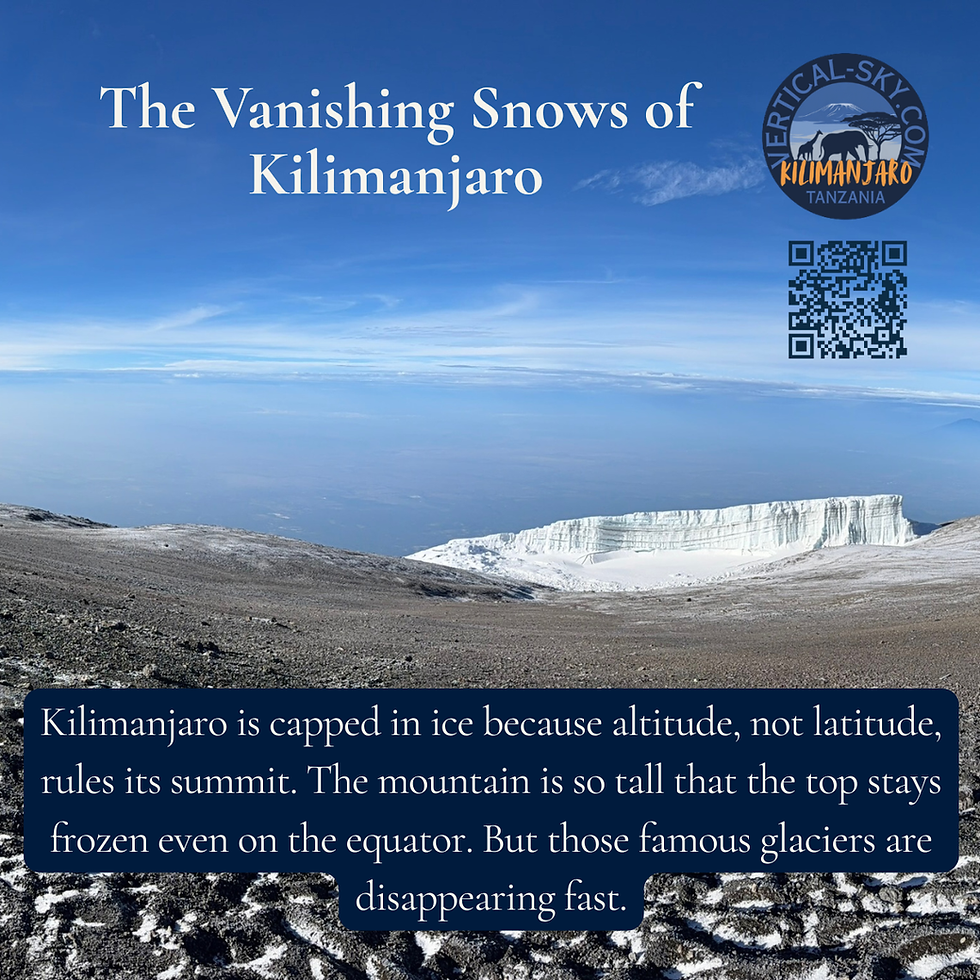
The final world is ice, glaciers, scree and bare rock. Almost nothing lives here, just lichens gripping the stones, and no animals at all. The cold is bitter, the sun on the snow is blinding, and the air holds roughly half the oxygen you would breathe at sea level. This is the frozen, silent realm where Hemingway placed his famous leopard, and where the green Uhuru Peak sign marks the highest point in Africa. After days of climbing through five worlds, you arrive on the roof of the continent.
Flora: next to none, only lichens on rock.
Wildlife: none.
Conditions: glacial cold, thin air and intense glare. The reward at the top of everything.
One mountain, five worlds
Very few places on earth let you walk from the equator to the arctic in a single week, watching the plants, the animals and the very air change around you as you go. It is one of the quiet wonders of Kilimanjaro, and a big part of why the mountain stays with people long after they come home.
It is also a reason to climb slowly. Go at the right pace, pole pole, and you actually get to see it: the colobus in the canopy, the giant lobelias in the mist, the ravens wheeling over the alpine desert. Rush it, and the whole living mountain blurs past. Our guides know every zone, every plant and every call, and a good guide turns the walk into a far richer thing than a slog to the top.
Frequently asked questions
How many climate zones does Kilimanjaro have?
Five. From bottom to top they are the cultivated lower slopes, the montane rainforest, the heath and moorland, the alpine desert, and the arctic summit zone. Each has its own temperature, rainfall, plants and wildlife, and they change as you gain height.
What animals might I see when climbing Kilimanjaro?
Most wildlife lives in the rainforest zone: blue monkeys, black and white colobus monkeys, bushbabies, tree hyrax, duikers and a huge variety of birds. Higher up, the white-necked raven follows climbers right up the mountain. Large animals such as elephant and buffalo live in the lower forest but are only rarely seen by trekkers.
What are the giant plants on Kilimanjaro?
They are the giant groundsels and giant lobelias of the moorland zone. These oversized, almost alien-looking plants grow in very few places on earth and have evolved special adaptations to survive freezing high-altitude nights, making them one of the most memorable sights on the mountain.
Is climbing Kilimanjaro the same as going on safari?
No. Climbing Kilimanjaro is a trek through the mountain's forest and alpine zones rather than a game drive, so you will see unique plants, monkeys and birds rather than the Big Five. Many climbers pair their climb with a safari elsewhere in Tanzania to enjoy both.
Climb it slowly, and see all five worlds
Ethical, expertly guided Kilimanjaro climbs, led by guides who know every plant, bird and call on the mountain.
Listen to the Podcast? Click on the link below:

Vertical Sky. Ethical Kilimanjaro climbs. Written by Vertical Sky.


Comments