
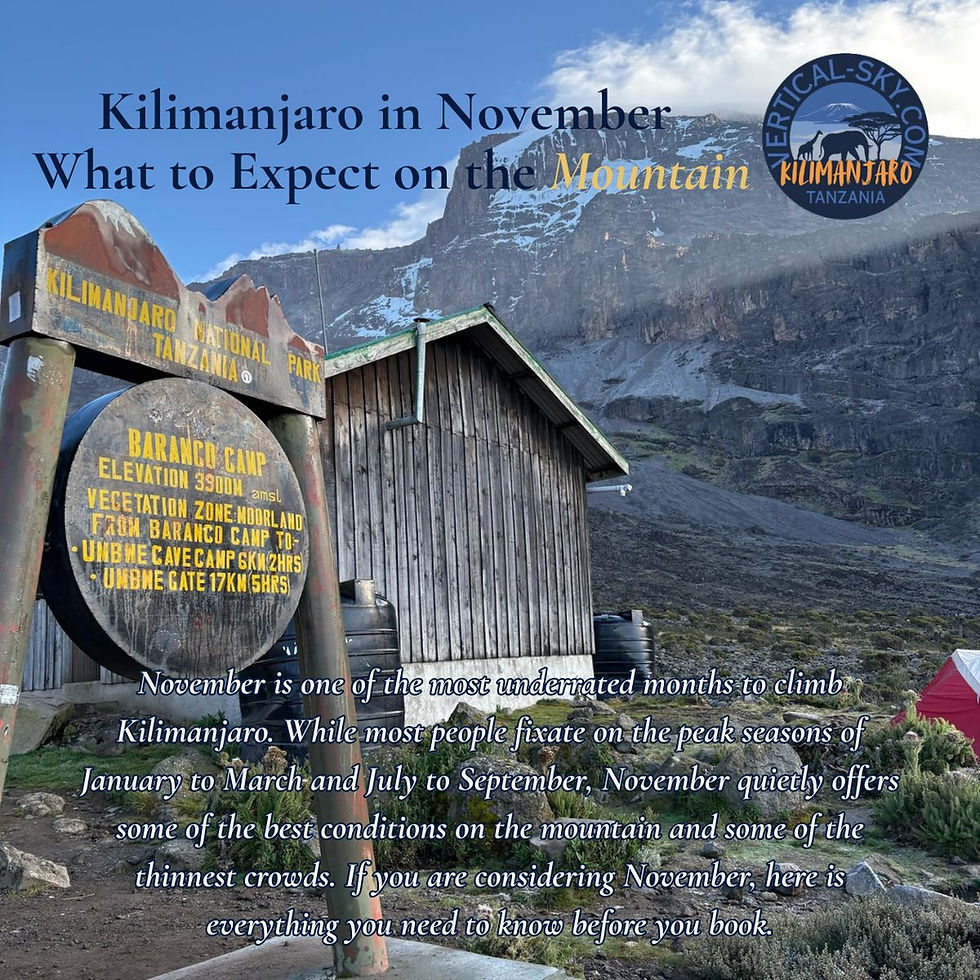
Kilimanjaro in November - What to Expect on the Mountain
November is one of the most underrated months to climb Kilimanjaro. While most people fixate on the peak seasons of January to March and July to September, November quietly offers some of the best conditions on the mountain and some of the thinnest crowds. If you are considering November, here is everything you need to know before you book.
The Short Answer on November Weather
November sits in the short rainy season on Kilimanjaro, which runs from late October through to early December. This sounds alarming. It is less alarming than it sounds. Here is why.
The rain on Kilimanjaro, even in the wet season, tends to fall in short, intense bursts rather than sustained all-day downpours. The mornings are typically clear. The rain arrives in the afternoon. The evenings often clear again. And at higher altitude, above 4,000 metres, the precipitation frequently falls as snow rather than rain, which most climbers find considerably more photogenic and considerably less miserable.
The summit views in November can be extraordinary. The post-rain atmosphere produces a clarity that the dry season does not always deliver. The glaciers look their most dramatic. The cloud inversions below the summit are some of the best of the year.
What November Actually Looks Like Day by Day on the Lemosho Route
Days One and Two — The Rainforest
The lower rainforest zones are lush in November. Properly, deeply, enthusiastically lush. The vegetation is at its most alive. The colours are extraordinary. You will get damp. This is not a disaster. Your waterproofs exist for exactly this. The forest is beautiful and the rain makes it more so.
Days Three and Four — The Moorland and Shira Plateau
Above 3,000 metres the landscape changes completely. The rainfall is less frequent here, the ground dryer, the clouds often sitting below you rather than around you. November mornings on Shira are frequently crystal clear with views across to Mawenzi and out over the plains of Africa that will stop your walking mid-step.
Days Five and Six — The Alpine Desert
Above 4,000 metres you are in the alpine desert zone. It is cold, dry, and dramatic regardless of what is happening lower down the mountain. November conditions here are largely indistinguishable from the peak dry season. The cold is the same. The wind is the same. The altitude is the same.
Summit Night
Summit night is summit night. It is cold, it is dark, it is windy, and it does not particularly care what month it is. November summit nights are entirely comparable to those in July or August. The preparation is identical. The challenge is identical. The reward is identical.
The Crowds - or the Lack of Them
This is where November becomes genuinely compelling. During the peak dry season months of July, August and September, Kilimanjaro is busy. The campsites are full. The paths are crowded. The gate queues are long. In November, the mountain is quieter. Significantly quieter. The camps have more space. The paths have more solitude. The experience is more private.
For families, for couples, for anyone who values space and quiet on what is already an intimate experience, November delivers something the peak season cannot.
What to Pack Differently for November
Your kit list for November is not dramatically different from any other month. The essentials remain identical: good waterproof boots, a quality down jacket, a sleeping bag rated to at least minus eighteen degrees, quality base layers, and baby wipes. But a few additions are worth making.
• A more substantial waterproof jacket than you might choose for the dry season. Make sure it is genuinely waterproof rather than water resistant. There is a significant difference.
• Gaiters. In November, the lower trails can be muddy in ways that will defeat even good boots without them.
• Extra dry bags for your kit inside your duffel. Your porter team will protect your bag but belt and braces is wise.
• Waterproof covers for your day pack. Non-negotiable in November.
Summit Success Rates in November
Summit success rates in November are comparable to the rest of the year when climbers are properly prepared and using an eight-day route. The short rainy season does not meaningfully reduce summit success for well-equipped, properly guided climbers. What reduces summit success is poor preparation, inadequate acclimatisation, and choosing a route that is too short. None of those are a November problem. They are a planning problem.
Why November Works for Our Clients
Vertical Sky operates year-round and has guided clients to the summit in every month. November produces some of our most memorable expeditions. The lush forest, the dramatic light, the quieter camps, the extraordinary clarity on the upper mountain after the afternoon showers have passed. It is a month that rewards the climber who is not afraid of a little weather and is willing to step away from the crowd.
Our November expedition departs on 21st November 2026. If you want to join a group of people who are training seriously, climbing ethically, and doing something genuinely extraordinary in one of the best kept months on the mountain, the link below is where to start.
Book your Kilimanjaro expedition at vertical-sky.com


Comments